The aerospace industry demands uncompromising standards for precision, material durability, and operational safety—standards that make CNC (Computer Numerical Control) machining a cornerstone of aerospace manufacturing. From jet engine components to airframe structures and avionics parts, CNC machining delivers the high-performance, consistent, and reliable components critical to airborne operations. This blog explores the pivotal role of CNC machining in aerospace, core industry requirements, key technologies, typical applications, and rigorous compliance frameworks.
Core Requirements for Aerospace-Grade CNC Machining
Aerospace components operate in extreme environments (high temperatures, high pressure, and intense vibration), so CNC machining in this sector must meet stringent, non-negotiable standards anchored by four core requirements:
Ultra-Precision & Dimensional Stability: Critical tolerances as tight as ±0.001mm, with strict control over geometric accuracy (e.g., flatness ≤0.002mm for engine turbine blades). Components must maintain dimensional stability under extreme temperature fluctuations (-55°C to 150°C).
High-Strength Material Compatibility: Proficiency in machining difficult-to-cut aerospace materials, including titanium alloys (Ti6Al4V), nickel-based superalloys (Inconel 718), carbon fiber composites, and stainless steel 316L—materials chosen for their high strength-to-weight ratio and heat resistance.
Strict Regulatory Compliance: Full adherence to aerospace standards such as AS9100 (quality management), NADCAP (special processes certification), and ISO 9001, with complete traceability of materials, processes, and testing data throughout production.
Lightweight & Structural Integrity: Optimized machining for lightweight designs (e.g., hollowed-out structures, thin walls) without compromising structural strength, directly contributing to fuel efficiency and aircraft performance.
Key CNC Machining Technologies for Aerospace Applications
Aerospace components’ complex geometries, high-strength material properties, and extreme performance demands drive the adoption of advanced, specialized CNC technologies:
1. Five-Axis Simultaneous Machining
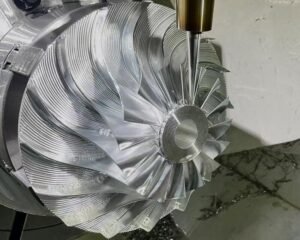
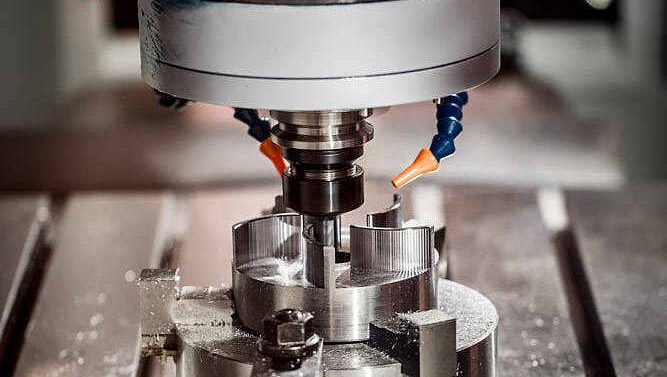
Applicable to: Jet engine blades, impellers, airframe structural components, and avionic housings. Core Advantages: Single-setup machining of complex curved surfaces and multi-angle features eliminates cumulative positioning errors. Achieves contour precision of ±0.002mm, ensuring optimal aerodynamic performance and structural fit.
2. High-Speed Cutting (HSC) Technology
Applicable to: Titanium alloy and superalloy components (e.g., engine casings, connecting rods). Core Advantages: High cutting speeds (up to 500m/min for milling) and feed rates reduce machining time by 30-50% compared to traditional cutting. Minimizes thermal deformation and tool wear, preserving material integrity and dimensional accuracy.
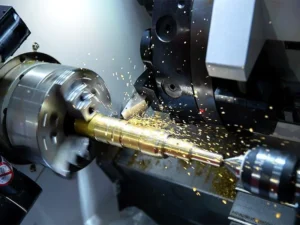
3. Turn-Mill Composite Machining
Applicable to: Slender aerospace components (e.g., fuel system pipes, landing gear pins). Core Advantages: Integrates turning, milling, drilling, and tapping in one setup, reducing handling times and improving coaxiality (≤0.003mm). Ensures consistent quality for high-precision rotating components.
4. Precision Grinding & Post-Processing
Core Processes: Creep feed grinding, electrolytic polishing (Ra≤0.05μm), and stress relief heat treatment. Core Advantages: Enhances surface finish, eliminates residual machining stress, and improves fatigue resistance—critical for components subjected to repeated vibration and load cycles.
Typical Applications of CNC Machining in Aerospace
1. Jet Engine Components
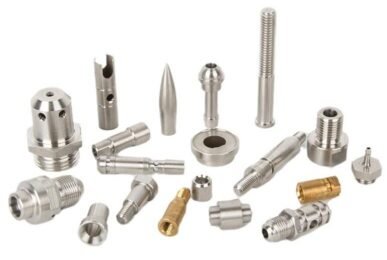
Representative Products: Turbine blades, compressor impellers, engine casings, and fuel nozzles. Key Highlights: Machined from nickel-based superalloys and titanium alloys via five-axis and high-speed cutting. Strict control over aerodynamic contours and surface finish to ensure efficient combustion and heat resistance.
2. Airframe & Landing Gear
Representative Products: Wing spars, fuselage frames, landing gear pins, and hydraulic system components. Key Highlights: Lightweight structural machining with high-strength materials; precision drilling and milling for bolted joints and load-bearing structures, complying with strict fatigue strength requirements.
3. Avionics & Navigation Components
Representative Products: Radar housings, sensor cores, and navigation system enclosures. Key Highlights: Machined from lightweight aluminum alloys and composites; micro-precision features (≤φ0.1mm holes) ensure electrical performance and signal integrity, with EMI shielding integration.
Compliance & Quality Control in Aerospace CNC Machining
Success in aerospace CNC machining relies on advanced technology paired with rigorous, end-to-end quality control and compliance:
Material Certification: All raw materials require aerospace-grade certification (e.g., AMS 4911 for Ti6Al4V, AMS 5662 for Inconel 718) and 100% compositional and defect testing (via X-ray and ultrasonic inspection).
In-Process Monitoring: Real-time monitoring via CMM (Coordinate Measuring Machine), laser interferometers, and force sensors. Critical processes are validated with first-article inspection (FAI) to ensure compliance.
Finished Product Validation: Fatigue testing, high-temperature performance testing, and non-destructive testing (NDT) such as eddy current and liquid penetrant inspection. Full compliance with AS9100 and NADCAP standards.
Traceability: Comprehensive data logging of materials, tooling, machining parameters, and testing results—ensuring full traceability for every component throughout its lifecycle.
Conclusion
CNC machining is an indispensable enabler of aerospace innovation, merging ultra-precision manufacturing with robust compliance to meet the industry’s extreme performance and safety demands. As aerospace evolves toward more fuel-efficient, electric, and autonomous aircraft, CNC machining continues to advance—with greater integration of digital twin technology, AI-driven process optimization, and composite material machining capabilities—laying the groundwork for next-generation aerospace systems.
For custom aerospace component machining needs (e.g., engine parts, airframe components, avionics), we provide tailored solutions covering material selection, process routing, and full regulatory compliance. Contact us to discuss your project requirements.