In the field of precision machining, CNC milling and CNC turning are two core processes that support the production of components for high-end industries such as aerospace, medical devices, and electronic communications. However, many purchasing professionals or design engineers often face confusion when advancing projects: both are precision machining processes, so how to choose between CNC milling and CNC turning? What are the core differences between them? What risks will arise from choosing the wrong process?
This article will break down the differences between CNC milling and CNC turning from 6 key dimensions including machining principles, core capabilities, and application scenarios, and share highly practical selection techniques to help you quickly match the appropriate machining process, avoiding cost waste and quality risks.
I. Core Differences: Understanding Essential Distinctions from "Motion Logic"
The core difference between CNC milling and CNC turning essentially stems from "the motion relationship between the workpiece and the tool" — this difference directly determines the machining capabilities and application scope of the two processes, and is also the primary basis for selection.
1. Core Motion Mode: Who Moves and Who Stays Stationary?
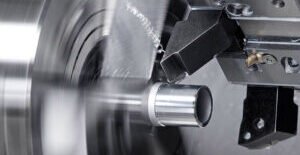
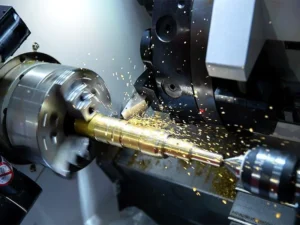
• CNC Turning: The workpiece rotates at high speed, while the tool is fixed on the turret and feeds linearly or curvilinearly along the workpiece's axis or radial direction. Simply put, it's "making the part rotate and the tool cut it", similar to peeling a rotating radish with a knife.
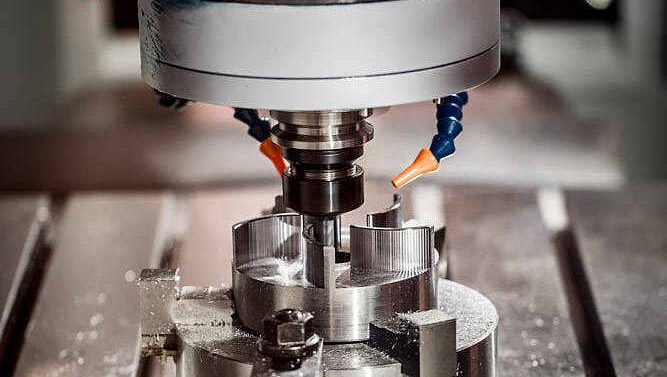
• CNC Milling: The tool rotates at high speed, while the workpiece is fixed on the worktable and fed through multi-axis linkage of the worktable (commonly 3-axis or 5-axis). Equivalent to "making the tool rotate to mill the fixed part", similar to grinding a fixed wooden block with a rotating grinding wheel.
2. Comprehensive Comparison Across 6 Key Dimensions
Comparison Dimension | CNC Turning (Including Swiss-Type Turning) | CNC Milling (Including 5-Axis Milling) |
Workpiece Shape | Limited to "rotational parts" (axisymmetric shapes), such as shafts, discs, sleeves, and tubes | Mainly "non-rotational parts"; capable of machining irregular shapes such as planes, grooves, complex cavities, and polyhedrons |
Core Machining Capabilities | Excellent at machining internal/external cylindrical surfaces, conical surfaces, threads (including variable-pitch threads), and arc surfaces; Swiss-Type Turning can precisely machine slender shafts (length-diameter ratio ≤ 30:1) | Excellent at machining planes, keyways, gears, cams, and complex curved surfaces; 5-axis milling enables "one-time clamping to machine all surfaces of complex parts" |
Precision & Surface Quality | Finish turning tolerance grade up to IT7-IT5, surface roughness Ra ≤ 0.01μm (mirror turning), especially superior in ensuring roundness and cylindricity | Finish milling tolerance grade up to IT8-IT6, surface roughness Ra ≤ 0.63μm, more advantageous in controlling geometric tolerances such as flatness and perpendicularity |
Machining Efficiency | Extremely high efficiency for mass production of rotational parts, with simple processes and short tool change time | Can improve efficiency for complex parts by reducing clamping times, but lower efficiency than turning for simple parts; programming and debugging time for multi-axis milling is longer |
Cost Threshold | Relatively low equipment and tool costs; obvious unit part cost advantage in mass production | Higher equipment (especially 5-axis milling) and tool costs, greater programming difficulty, and higher cost for small-batch production |
Typical Equipment | Standard CNC lathes, Swiss-Type Lathes (Swiss Screw Machines) | 3-axis CNC milling machines, 4-axis/5-axis CNC machining centers |
II. Application Scenarios: Which Parts Suit Turning? Which Suit Milling?
Understanding the core differences, let's combine practical cases to help you quickly judge "which process suits your part".
1. Typical Application Scenarios for CNC Turning
If the part is "axisymmetric", prioritize CNC turning, especially for the following cases:
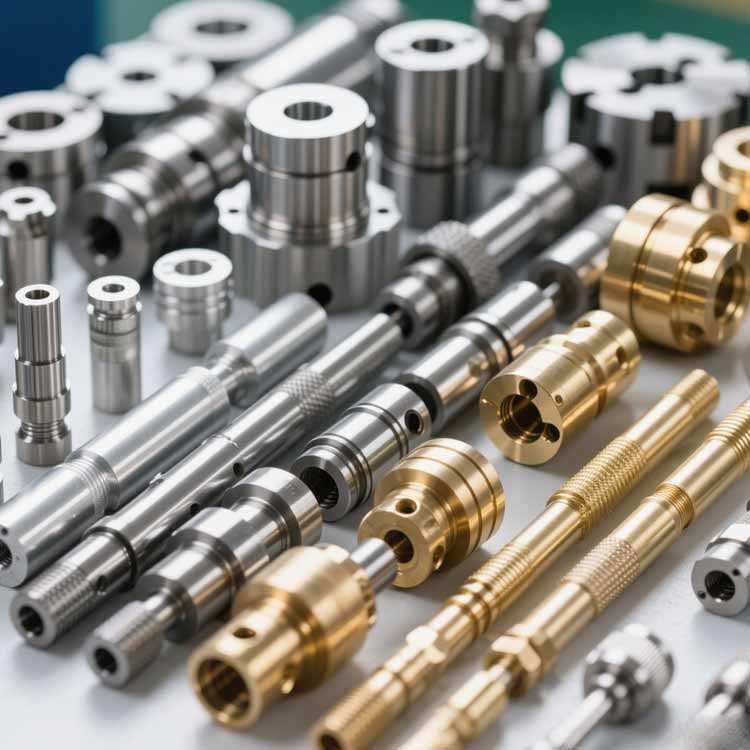
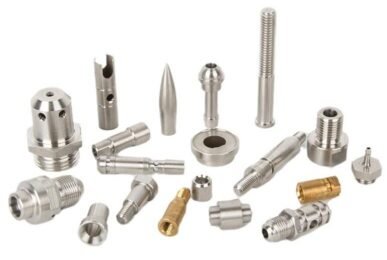
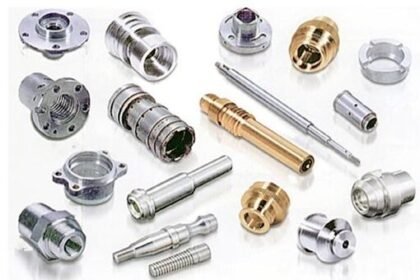
• Shaft parts: Such as aerospace hydraulic pins, medical surgical instrument shafts, electronic connector shafts (Swiss-Type Turning is preferred for slender shafts with diameter 1-38mm);
• Disc/sleeve parts: Such as bearing seats, flanges, hydraulic valve sleeves, and automotive wheel hubs;
• Threaded parts: Such as precision screws, nuts, and pipe fittings (turning can precisely machine high-precision threads).
Case Study: A medical enterprise needed to machine slender orthopedic implant shafts (length-diameter ratio 25:1, tolerance ±0.005mm). Finally, Swiss-Type Turning was selected, which not only ensured deformation-free machining but also achieved a surface finish of Ra ≤ 0.025μm, meeting biocompatibility requirements.
2. Typical Application Scenarios for CNC Milling
CNC milling is a better choice for parts with irregular shapes, complex curved surfaces, or polyhedral structures:
• Complex cavity parts: Such as aerospace engine blades, medical device housings, and mold cavities;
• Plane/groove parts: Such as machine tool worktables, gearbox housings, and precision fixtures;
• Integrated multi-feature parts: Such as comprehensive parts with planes, holes, and grooves (5-axis milling can complete all machining in one clamping).
Case Study: An aerospace enterprise's hydraulic valve core had complex deep cavities and cross holes. 5-axis CNC milling was selected, avoiding positioning errors caused by multiple clampings. Finally, geometric tolerance ≤ 0.002mm was achieved, meeting the AS9100 aerospace industry standard.
3. Special Case: Collaborative Machining of Both Processes
Many complex precision parts require the collaboration of both processes: For example, first use turning to machine the shaft blank, then use milling to process asymmetric features such as keyways and radial holes on the shaft; or first use milling to machine the complex cavity of the part, then use turning to finish the inner hole to ensure roundness accuracy.
III. Selection Techniques: 3 Steps to Quickly Determine the Appropriate Process
When facing specific part requirements, follow these 3 steps to avoid choosing the wrong process:
Step 1: Check the workpiece shape — Is it a rotational part? Yes → Prioritize turning; No → Prioritize milling;
Step 2: Check precision requirements — Need strict roundness and cylindricity → Choose turning; Need flatness and complex surface precision → Choose milling;
Step 3: Check batch size and cost — Small-batch complex parts → Consider milling (reduce clamping); Mass-produced rotational parts → Must choose turning (improve efficiency and reduce cost).
IV. Conclusion: No "Better", Only "More Suitable"
There is no absolute superiority between CNC milling and CNC turning; the core is matching part requirements:
• Rotational parts, high precision, mass production → Choose CNC turning (Swiss-Type Turning for small-diameter slender shafts);
• Non-rotational parts, complex structures, small batches → Choose CNC milling (5-axis milling for high-difficulty parts).
If your part has a complex structure, or has special requirements for precision and materials (such as titanium alloy, PEEK), and it's difficult to judge the process selection, you may wish to entrust it to a professional precision machining service provider.
Upload your part's 2D/3D drawings, and our engineers will provide you with free process evaluation, selection advice, and accurate quotation within 24 hours, helping you avoid machining mistakes and control costs and quality!